
Quick Index
Essential Oil Index full story...
New! A Mother's Wisdom
Single Subject Index
Colloidal Silver and Censorship
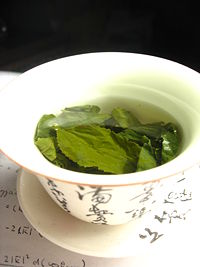
Green tea is a type of tea made solely with the leaves of Camellia sinensis, that has undergone minimal oxidation during processing. Green tea originates from China and has become associated with many cultures in Asia from Japan to the Middle East. Recently, it has become more widespread in the West, where black tea is traditionally consumed. Many varieties of green tea have been created in countries where it is grown. These varieties can differ substantially due to variable growing conditions, processing and harvesting time.

Over the last few decades green tea has been subjected to many scientific and medical studies to determine the extent of its long-purported health benefits, with some evidence suggesting regular green tea drinkers may have lower chances of heart disease and developing certain types of cancer.[1] Green tea has also been claimed useful for weight loss management.
Generally, 2 grams of tea per 100ml of water, or about one teaspoon of green tea per 5 ounce cup, should be used. With very high quality teas like gyokuro, more than this amount of leaf is used, and the leaf is steeped multiple times for short durations.
Green tea brewing time and temperature varies with individual teas. The hottest brewing temperatures are 180°F to 190°F (81°C to 87°C) water and the longest steeping times 2 to 3 minutes. The coolest brewing temperatures are 140°F to 160°F (61°C to 69°C) and the shortest times about 30 seconds. In general, lower quality green teas are steeped hotter and longer, while higher quality teas are steeped cooler and shorter. Steeping green tea too hot or too long will result in a bitter, astringent brew for low quality leaves. High quality green teas can be and usually are steeped multiple times; 2 or 3 steepings is typical. The brewing technique also plays a very important role to avoid the tea developing an overcooked taste. Preferably, the container in which the tea is steeped or teapot should also be warmed beforehand so that the tea does not immediately cool down.
Unless specifically decaffeinated, green tea contains caffeine.[3] Normal green tea itself may contain more caffeine than coffee, but the length of infusion with hot water and the amount of time you use the green tea leaves can greatly alter your caffeine intake.[3] Experiments have shown after the first 5 minutes of brewing, green tea contains 32 mg caffeine.[3] But if the same leaves are then used for a second and then a third five minute brew, the caffeine drops to 12 mg and then 4 mg.[3]
While coffee and tea are both sources of caffeine, the amounts of caffeine in any single serving of these beverages varies significantly. An average serving of coffee contains the most caffeine, yet the same serving size of tea provides only 1/2 to 1/3 as much.(Ref.: Caffeine by The Institute of Food Technologists' Expert Panel on Food Safety & Nutrition.) One of the more confusing aspects of caffeine content is the fact that coffee contains less caffeine than tea when measured in its dry form. The caffeine content of a prepared cup of coffee is significantly higher than the caffeine content of a prepared cup of tea.[4]]
Green teas contain two caffeine metabolites (caffeine-like substances): theophylline, which is stronger than caffeine, and theobromine, which is slightly weaker than caffeine.[citation needed]
Green tea contains polyphenols which are thought to improve health, particularly catechins, the most abundant of which is epigallocatechin gallate. In vitro and animal studies as well as preliminary observational and clinical studies of humans suggest that green tea can reduce the risk of cardiovascular disease and cancer as well as beneficially impact bone density, cognitive function, dental caries, and kidney stones. However, the human studies are sometimes mixed and inconsistent.[5] Green tea also contains carotenoids, tocopherols, ascorbic acid (vitamin C), minerals such as Cr, Mn, Se or Zn, and certain phytochemical compounds. It is a more potent antioxidant than black tea,[6] although black tea has substances which green tea does not such as theaflavin.
Green tea consumption is epidemiologically associated with reduced heart disease, and animal studies have found that it can reduce cholesterol. However, several small, brief human trials found that tea consumption did not reduce in cholesterol in humans. In 2003 a randomized clinical trial found that a green tea extract with added theaflavin from black tea reduced cholesterol.[7]
In a study performed at Birmingham (UK) University, it was shown that average fat oxidation rates were 17% higher after ingestion of green tea Extract than after ingestion of a placebo.[8] Similarly the contribution of fat oxidation to total energy expenditure was also significantly higher by a similar percentage following ingestion of green tea extract. This implies that ingestion of green tea extract can not only increase fat oxidation during moderately intensive exercise but also improve insulin sensitivity and glucose tolerance in healthy young men.
In a study performed at the Technion, it was shown that the main antioxidant polyphenol of green tea extract, EGCG, when fed to mice induced with Parkinson's and Alzheimer's disease, helped to protect brain cells from dying, as well as 'rescuing' already damaged neurons in the brain, a phenomenon called neurorescue or neurorestoration. The findings of the study, led by Dr. Silvia Mandell, were presented at the Fourth International Scientific Symposium on Tea and Human Health in Washington D.C., in 2007. Resulting tests underway in China, under the auspices of the Michael J. Fox Foundation, are being held on early Parkinson's patients. [9]
In a recent case-control study of the eating habits of 2,018 women, consumption of mushrooms and green tea was linked to a 90% lower occurrence of breast cancer.[10]
Tea consumption had its origin in China more than 4000 years ago.[11] Green tea has been used as traditional medicine in areas such as China, Japan, India and Thailand to help everything from controlling bleeding and helping heal wounds to regulating body temperature, blood sugar and promoting digestion.
The Kissa Yojoki (Book of Tea), written by Zen priest Eisai in 1191, describes how drinking green tea can have a positive effect on the five vital organs, especially the heart. The book discusses tea's medicinal qualities, which include easing the effects of alcohol, acting as a stimulant, curing blotchiness, quenching thirst, eliminating indigestion, curing beriberi disease, preventing fatigue, and improving urinary and brain function. Part One also explains the shapes of tea plants, tea flowers, and tea leaves, and covers how to grow tea plants and process tea leaves. In Part Two, the book discusses the specific dosage and method required for individual physical ailments.
Green tea has been credited with providing a wide variety of health benefits, many of which have not been validated by scientific evidence. These claims and any for which academic citations are currently missing are listed here:
According to research reported at the Sixth International Conference on Frontiers in Cancer Prevention, sponsored by the American Association for Cancer Research, a standardized green tea polyphenol preparation (Polyphenon E) limits the growth of colorectal tumors in rats treated with a substance that causes the cancer. "Our findings show that rats fed a diet containing Polyphenon E are less than half as likely to develop colon cancer," Dr. Hang Xiao, from the Ernest Mario School of Pharmacy at Rutgers University, Piscataway, New Jersey, noted in a statement.
A 2006 study published in the September 13 issue of the Journal of the American Medical Association concluded "Green tea consumption is associated with reduced mortality due to all causes and due to cardiovascular disease but not with reduced mortality due to cancer." The study, conducted by the Tohoku University School of Public Policy in Japan, followed 40,530 Japanese adults, ages 40–79, with no history of stroke, coronary heart disease, or cancer at baseline beginning in 1994. The study followed all participants for up to 11 years for death from all causes and for up to 7 years for death from a specific cause. Participants who consumed 5 or more cups of tea per day had a 16 percent lower risk of all-cause mortality and a 26 percent lower risk of cardiovascular disease ("CVD") than participants who consumed less than one cup of tea per day. The study also states, "If green tea does protect humans against CVD or cancer, it is expected that consumption of this beverage would substantially contribute to the prolonging of life expectancy, given that CVD and cancer are the two leading causes of death worldwide."[24] [25]
A study in the February 2006 edition of the American Journal of Clinical Nutrition concluded "A higher consumption of green tea is associated with a lower prevalence of cognitive impairment in humans."[26][27][dubious – discuss]
In May 2006, researchers at Yale University School of Medicine weighed in on the issue with a review article that looked at more than 100 studies on the health benefits of green tea. They pointed to what they called an "Asian paradox," which refers to lower rates of heart disease and cancer in Asia despite high rates of cigarette smoking. They theorized that the 1.2 liters of green tea that is consumed by many Asians each day provides high levels of polyphenols and other antioxidants. These compounds may work in several ways to improve cardiovascular health, including preventing blood platelets from sticking together (This anticoagulant effect is the reason doctors warn surgical patients to avoid green tea prior to procedures that rely on a patient's clotting ability) and improving cholesterol levels, said the researchers, whose study appeared in the May issue of the Journal of the American College of Surgeons. Specifically, green tea may prevent the oxidation of LDL cholesterol (the "bad" type), which, in turn, can reduce the buildup of plaque in arteries, the researchers wrote.[28]
A study published in the August 22, 2006 edition of Biological Psychology looked at the modification of the stress response via L-Theanine, a chemical found in green tea. It "suggested that the oral intake of L-Theanine could cause anti-stress effects via the inhibition of cortical neuron excitation."[29]
In a double-blind, randomized, placebo-controlled trial done by Division of Cardiovascular Medicine, Vanderbilt University Medical Center, Nashville, Tennessee, 240 adults were given either theaflavin-enriched green tea extract in form of 375 mg capsule daily or a placebo. After 12 weeks, patients in the tea extract group had significantly less low-density lipoprotein cholesterol (LDL-C) and total cholesterol (16.4% and 11.3% lower than baseline, p<0.01) than the placebo group. The author concluded that theaflavin-enriched green tea extract can be used together with other dietary approaches to reduce LDL-C.
A study published in the January, 2005 edition of the American Journal of Clinical Nutrition concluded "Daily consumption of tea containing 690 mg catechins for 12 wk reduced body fat, which suggests that the ingestion of catechins might be useful in the prevention and improvement of lifestyle-related diseases, mainly obesity." [30]
According to a Case Western Reserve University School of Medicine study published in the April 13 2005 issue of the Proceedings of the National Academy of Sciences, antioxidants in green tea may prevent and reduce the severity of rheumatoid arthritis. The study examined the effects of green tea polyphenols on collagen-induced arthritis in mice, which is similar to rheumatoid arthritis in humans. In each of three different study groups, the mice given the green tea polyphenols were significantly less likely to develop arthritis. Of the 18 mice that received the green tea, only eight (44 percent) developed arthritis. Among the 18 mice that did not receive the green tea, all but one (94 percent) developed arthritis. In addition, researchers noted that the eight arthritic mice that received the green tea polyphenols developed less severe forms of arthritis.
A German study found that an extract of green tea and hot water (filtered), applied externally to the skin for 10 minutes, three times a day could help people with skin damaged from radiation therapy (after 16–22 days). [31]
A study published in the December 1999 American Journal of Clinical Nutrition found that "Green tea has thermogenic properties and promotes fat oxidation beyond that explained by its caffeine content per se. The green tea extract may play a role in the control of body composition via sympathetic activation of thermogenesis, fat oxidation, or both."[32]
In lab tests, EGCG, found in green tea, was found to prevent HIV from attacking T-Cells. However, it is not yet known if this has any effect on humans. [33]
A study in the August, 2003 issue of a new potential application of Cellular and Molecular Life Sciences found that "a new potential application of (–)-epigallocatechin-3-gallate [a component of green tea] in prevention or treatment of inflammatory processes is suggested" [34]
However, pharmacological and toxicological evidence does indicate that green tea polyphenols can in fact cause oxidative stress and liver toxicity in vivo at certain concentrations. [35] This would imply that consumers should exercise caution when consuming herbal products produced from concentrated green tea extract. Other evidence presented in the review cautions against the drinking of green tea by pregnant women. [36]
Drug Interactions
A 2009 study at the University of Southern California using mouse models showed that several of the polyphenolic ingredients of green tea, such as EGCG, can bind with the anticancer drug bortezomib, significantly reducing its bioavailability and thereby rendering it therapeutically useless.[37] This chemical reaction between EGCG and bortezomib is highly specific and depends on the presence of a boronic acid functional group in the bortezomib molecule. Dr. Schönthal, who headed the study, suggests that consumption of green tea, concentrated green tea extract, and other green tea products (such as EGCG capsules) be strongly contraindicated for patients undergoing bortezomib treatment.[
 Green Tea is high in antioxidants and shows possibility in Cancer Prevention, however it has been found to block the benefits of one cancer drug. Green tea contains caffeine. Extracts of Green Tea are available in capsules, and are often used in skin care products.
Nutritional scientist studies impact of green tea on liver disease
Green Tea May Obstruct HIV Infection
Green Tea Blocks Cancer Drug Benefit Velcade in Tumor Bearing Mice Science Daily
Will Drinking Green Tea Help you Dodge Cancer?
Green Tea May Protect Against Breast Cancer
Green Tea, Not a Miracle Cure but Close


